Flexible electronics and wearable devices are among the fastest-growing segments in modern manufacturing. Continuous glucose monitors, smart textile sensors, flexible displays, and IoT patch devices are moving from prototype to high-volume production, and every one of them presents an interconnect problem that solder cannot solve.
Reflow soldering requires rigid substrates, process temperatures that PET and TPU cannot survive, and joint geometries that crack within the first few hundred flex cycles. The substrates and form factors that define flexible electronics are precisely the ones that make traditional joining methods fail.
Conductive adhesives for flexible electronics address this directly, combining electrical conductivity with the mechanical compliance that flexible substrates and repeated deformation demand. At Kohesi Bond, we engineer conductive adhesive for wearable electronics systems where flexibility, conductivity, and substrate compatibility are co-optimised from the formulation level, not traded off against each other.
Table of Contents
ToggleA] Understanding Flexible Electronics and Wearable Devices
1. What Defines Flexible Electronics
Flexible electronics are built on substrates that bend, conform, and, in some designs, stretch while maintaining electrical function. This shift toward pliable hardware has increased the demand for specialised electronics adhesives that can survive dynamic environments. Flexible PCBs route signals across dynamic geometries. Printed electronics deposit functional layers directly onto polymer films. Stretchable circuits accommodate the deformation of skin-worn sensors without loss of electrical continuity. In each case, the interconnect material must move with the substrate rather than resist it.
2. Key Materials Used in Flexible Devices
Polyimide (Tg ~360°C) offers the highest thermal stability among flexible substrate materials and is used where process temperatures demand it. PET (Tg ~70-80°C) dominates cost-sensitive wearable and consumer flexible applications. TPU provides the extensibility required for truly stretchable electronics but imposes the tightest process temperature ceiling of any common substrate, with dimensional distortion beginning below 60°C in some grades. Any joining process must be evaluated against the thermal and mechanical limits of the specific substrate in the assembly.
3. Typical Applications
Wearable health monitors measure continuous physiological signals, requiring adhesive joints that maintain stable contact resistance through thousands of flex cycles against skin-worn substrates. Smart textiles integrate electronic function into garment structures that wash, stretch, and compress repeatedly. Flexible displays and sensor arrays require precise, fine-pitch interconnection across surfaces that curve in use.
4. Reliability Challenges
A flex circuit bonded at the wrist experiences an estimated 1-3 million bend cycles over a typical wearable product lifetime. Each cycle generates strain at every bond interface. Joints that pass initial electrical testing but lack fatigue resistance fail progressively, with resistance rising incrementally across cycles until signal integrity is lost. This makes electrically conductive adhesives for microelectronic packaging a superior choice for high-reliability medical and consumer wearables.
B] Why Conductive Adhesives Are Ideal for Flexible Electronics
1. Low-Temperature Processing
Low-temperature curing conductive adhesive systems cure at 60-100°C, well below the dimensional stability thresholds of PET, TPU, and thin polyimide films under process stress. This is not a marginal improvement over solder reflow; it is the difference between a substrate that survives the joining process dimensionally intact and one that warps, shrinks, or loses its functional geometry before the first component is tested.
2. Mechanical Flexibility
Solder joints are rigid and brittle. Under repeated bending, stress concentrates at the joint edge, and fatigue cracking initiates within a predictable number of cycles determined by the applied strain amplitude. A crosslinked epoxy or acrylic adhesive matrix deforms viscoelastically under the same loading, absorbing strain energy across the bond volume rather than concentrating it at a crack initiation site. The result is bond fatigue life measured in millions of cycles rather than thousands.
3. Electrical Performance in Compact Assemblies
Conductive adhesive for flexible circuits achieves bulk resistivity in the range of 1×10⁻⁴ to 1×10⁻³ Ω·cm through conductive filler networks within the polymer matrix. For signal-level interconnects in wearable sensors, this resistivity range is fully adequate. The critical specification is resistivity stability under deformation: a joint that measures 5×10⁻⁴ Ω·cm flat but rises to 5×10⁻³ Ω·cm at a 90° bend has failed its primary function regardless of its as-cured value.
4. Lightweight and Thin Bond Lines
Flexible electronics conductive bonding solution approaches using adhesive rather than solder eliminate the mass of metallic joints and flux residues, contributing to the weight targets that wearable and implantable devices impose. Bond line thicknesses of 10-50 µm are achievable with controlled dispensing, maintaining the low-profile geometries that flexible form factors require.
5. Kohesi Bond’s Flexible Electronics Approach
Kohesi Bond formulates silver conductive adhesive for electronics systems for flexible applications with filler morphology, resin flexibility, and cure chemistry selected together. Conductivity, adhesion to low-surface-energy polymer substrates, and fatigue resistance under cyclic bending are all validated as a set, because optimising one in isolation while the others fail in service is not an engineering solution.
C] Types of Conductive Adhesives Used in Flexible Devices
1. Silver-Filled Conductive Adhesives
Silver-filled epoxy and acrylic systems deliver the lowest bulk resistivity available in adhesive form, typically 1×10⁻⁴ to 5×10⁻⁴ Ω·cm, through silver flake networks above the percolation threshold. Silver oxide is conductive, which prevents the resistance creep over service life that affects copper and nickel-filled alternatives when exposed to the humidity cycling that wearable devices experience continuously. For signal transmission, grounding, and component attachment on flexible substrates, silver-filled systems are the baseline specification.
2. Carbon-Based Conductive Adhesives
Carbon black and graphene-filled adhesive systems offer lower conductivity than silver, typically 1×10⁻² to 1×10⁻¹ Ω·cm, but provide inherently better mechanical compliance and lower cost per unit area. For applications where absolute resistivity is less critical than flexibility and formability, such as resistive strain sensors and printed antenna elements on textile substrates, carbon-based systems offer a practical alternative to silver loading.
3. Anisotropic Conductive Adhesives
Anisotropic conductive adhesive film ACF conducts only in the Z-axis through the bond line thickness while remaining insulating in X and Y. This is achieved by dispersing conductive particles at a concentration below the lateral percolation threshold but sufficient to bridge opposing pad surfaces under the compression of bonding. ACF is the enabling technology for fine-pitch flex-to-rigid and flex-to-display interconnection, where pad pitches below 0.1 mm make any laterally conductive adhesive a bridging risk.
4. Hybrid Conductive Systems
Stretchable conductive adhesive formulations combine conductive filler networks with elastomeric matrices, typically silicone or polyurethane-based, to maintain conductivity under tensile strains of 20-100%. These systems are used in skin-conformal biosensors and electronic skin applications where the substrate itself stretches rather than simply bends. Resistivity increases with applied strain and recovers on release; the design requirement is that this change remains within acceptable limits across the strain amplitude and cycle count the application demands.
Need reliable conductive adhesives for flexible electronics and wearables?
Kohesi Bond delivers high-performance bonding solutions built to last.
D] Key Performance Requirements for Wearable Electronics
1. Flexibility and Fatigue Resistance
The governing fatigue relationship for adhesive joints under cyclic bending follows:
N_f = C × (Δε)^(-k)
Where:
- N_f = number of cycles to failure
- C = material-dependent fatigue ductility coefficient
- Δε = strain amplitude per cycle at the bond interface
- k = fatigue exponent (typically 1.5-3.0 for polymer adhesive systems)
Reducing Δε by distributing strain across a longer bond length, or selecting a lower-modulus adhesive that reduces stress transfer to the joint interface, extends N_f directly. For a wrist-worn device experiencing 1 million flex cycles, achieving N_f above this threshold is a non-negotiable qualification requirement, not a performance aspiration.
2. Adhesion to Flexible Substrates
PET and TPU are low-surface-energy substrates with surface energies of 40-45 mJ/m² and 35-42 mJ/m², respectively. Standard epoxy adhesives formulated for metal or ceramic surfaces achieve inadequate peel strength on these materials without surface activation. Corona treatment, plasma activation, or chemical priming raises surface energy above 50 mJ/m², the practical threshold for reliable adhesive bonding, and must be specified as part of the assembly process rather than left to operator judgement.
3. Environmental Stability
Wearable devices operate against skin in conditions of continuous humidity, sweat exposure, and body-temperature thermal cycling. Sweat is a complex electrolyte with a pH ranging from 4.5 to 7.5 and ionic species, including sodium, potassium, and chloride, that drive electrochemical degradation at conductive interfaces. Conductive adhesive for wearable electronics must demonstrate stable contact resistance and adhesion after extended exposure to simulated sweat per ISO 105-E04 or equivalent, not just damp heat testing conducted under less aggressive conditions.
4. Electrical Stability Under Deformation
Resistivity increase under bending is a fundamental consequence of filler network disruption at the adhesive joint. The acceptable limit depends on circuit function: a 2x increase in resistance is inconsequential for a digital signal line but catastrophic for a precision analogue sensor measurement. Electrical stability under deformation must therefore be specified per signal type and validated at the maximum bend radius and deformation frequency the device will experience in use.
E] Design and Processing Considerations
1. Surface Preparation for Flexible Substrates
Beyond surface energy activation, flexible substrate surfaces must be free of mould release agents, processing lubricants, and handling contamination accumulated during film manufacture. These contaminants are not always visible and are not removed by solvent wiping alone. Plasma cleaning followed by immediate adhesive application within a controlled time window is the most reliable protocol for achieving consistent peel strength on PET and TPU in production.
2. Dispensing and Patterning Methods
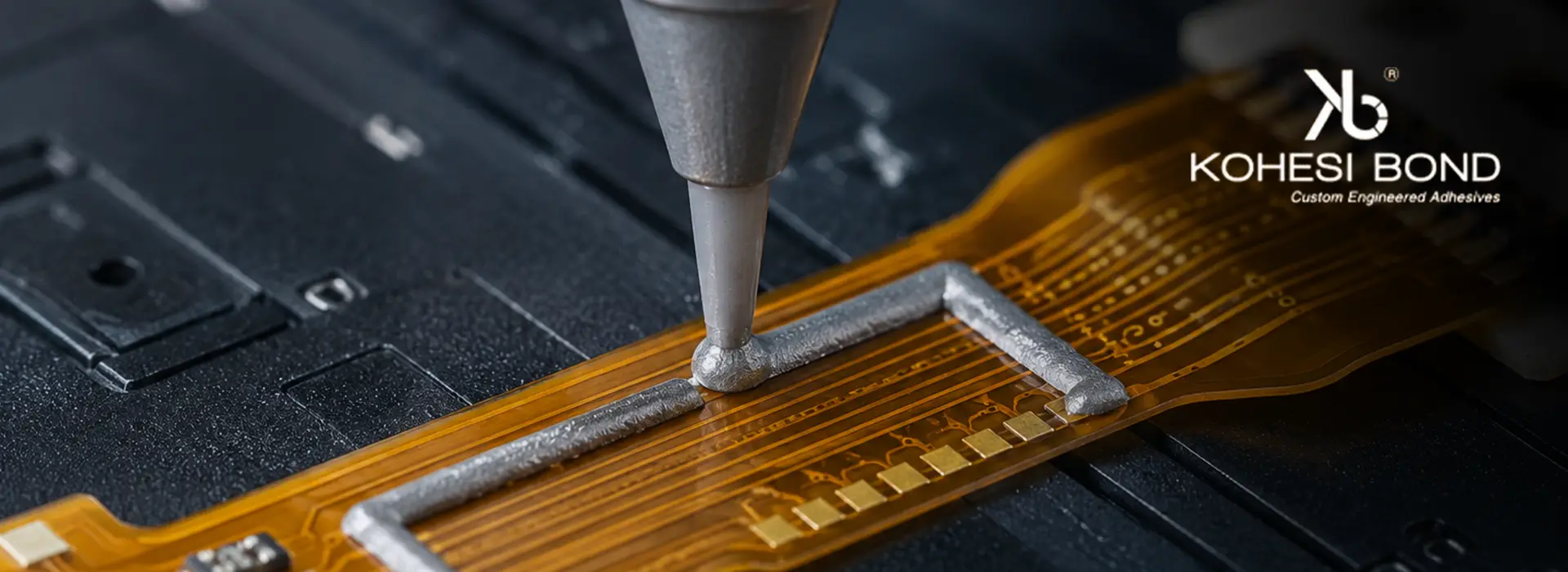
Screen printing and stencil printing deposit conductive adhesive across large areas with controlled thickness in a single step, suited to high-volume flexible circuit production. Jet dispensing provides the placement precision for fine-pitch component attachment and rework without tooling changes. The choice between them is driven by feature geometry: screen printing for broad conductor paths and area bonds, and jet dispensing for discrete component deposits where placement accuracy below 50 µm is required.
3. Cure Profile and Process Compatibility
Conductive adhesive manufacturers for electronics targeting flexible substrate applications formulate systems that complete cure below the substrate’s dimensional stability threshold. For PET assemblies, this means achieving target Tg and resistivity at or below 75°C. Confirmation requires DSC measurement of residual cure enthalpy on coupons cured at production temperature and time, ensuring the cure is genuinely complete rather than merely handle-stable.
4. Process Validation and Testing
Fatigue validation requires cyclic bending test rigs that apply the target bend radius at representative frequency, with four-point resistance measurement at defined intervals to capture the gradual resistance rise that precedes open-circuit failure. Peel adhesion testing after simulated sweat exposure confirms that environmental resistance is maintained at the adhesive-substrate interface. These tests must be conducted on production-representative assemblies, not on idealised laboratory specimens.
F] How Kohesi Bond Supports Flexible Electronics Innovation
1. Tailored Conductive Adhesive Formulations
Kohesi Bond’s electrically conductive adhesives for PCB and flexible substrate systems are formulated with the specific combination of conductivity, flexibility, and substrate adhesion that wearable applications demand. Filler type, loading, particle morphology, and matrix elasticity are all co-optimised for the target substrate and deformation profile, not defaulted to a standard silver-epoxy formulation with flexibility treated as an afterthought.
2. Application-Specific Material Selection
No single formulation is correct across the full range of flexible electronics applications. A skin-worn biosensor on TPU has different requirements from an ACF bond on a flex-to-display interface or a stretchable antenna on a textile substrate. Kohesi Bond’s selection process starts with the substrate material, deformation requirements, and operating environment, then identifies the formulation that satisfies all three simultaneously.
3. Engineering Collaboration
Kohesi Bond works with flexible electronics manufacturers through material selection, surface preparation protocol development, cure profile optimisation, and fatigue qualification testing. Full TDS, SDS, and CoC documentation accompanies every order. For regulated medical wearable applications, additional biocompatibility documentation is available to support design history file requirements.
Conclusion
Flexible electronics and wearables are not a niche segment moving toward the mainstream; they are already mainstream, and the manufacturing challenge they present is acute. Solder fails on the substrates they require, at the process temperatures they can tolerate, and under the mechanical loading they experience in use.
Conductive adhesives resolve each of these constraints directly, providing electrical interconnection, substrate compatibility, and fatigue resistance that traditional joining methods cannot deliver on flexible form factors. As a leading high-temperature adhesive provider in India, Kohesi Bond offers formulations engineered for this operating reality. Contact our applications team to discuss your specific substrate, deformation profile, and reliability requirements.
Looking for durable conductive adhesive solutions?
Trust Kohesi Bond for precision-engineered products designed for flexible electronic applications.
FAQs
They provide electrical interconnection and mechanical bonding on polymer substrates that solder cannot join without substrate damage or joint fatigue failure. In wrist-worn sensors experiencing over 1 million bend cycles across a product lifetime, a well-formulated conductive adhesive joint maintains stable contact resistance where a solder joint would initiate fatigue cracking within the first few thousand cycles.
Because PET and TPU substrates distort at temperatures well below solder reflow, and solder joints are brittle under the cyclic bending that wearable form factors impose continuously. A conductive adhesive curing at 75°C on a PET substrate protects dimensional integrity during assembly; its viscoelastic matrix then absorbs flex cycle strain energy rather than concentrating it at a crack initiation site.
Silver-filled epoxy systems for component attach and signal interconnection where low resistivity is required; carbon-based systems where mechanical compliance and cost per area matter more than absolute conductivity; and anisotropic conductive adhesive film for fine-pitch flex-to-rigid and flex-to-display bonds where lateral insulation between adjacent pads is a design requirement.
By maintaining stable electrical performance under the mechanical and environmental conditions wearables actually experience: continuous bending, sweat exposure, and body-temperature humidity cycling. A silver-filled adhesive system that passes ISO 105-E04 simulated sweat testing and retains resistivity within specification after 1 million flex cycles enables reliable biometric measurement across the product’s full service life.
Start with the substrate: its Tg sets the maximum cure temperature, and its surface energy determines whether adhesion primers or plasma activation are required. Then define the deformation profile, specifically the minimum bend radius and total cycle count, to specify the fatigue life requirement. Finally, quantify the acceptable resistivity change under deformation for the specific signal types in the circuit. Kohesi Bond’s engineering team can match these requirements to a validated formulation.

Utsav Shah is a 34-year-old entrepreneur with a passion for scientific discovery. Utsav’s journey began with a deep dive into materials science, earning degrees from USC and the Institute of Chemical Technology. He’s the visionary founder of Kohesi Bond, a top-rated adhesive manufacturer, and Cenerge Engineering Solutions, a leader in heat exchangers and cryogenic pumps. With over a decade of experience, Utsav consults across various industries, ensuring they have the perfect adhesive solution for their needs. Connect with him on LinkedIn!